Similarly to how Jeep had produced the FC-150 and FC-170 Forward Control trucks, Land Rover, too; has produced a Forward Control model.
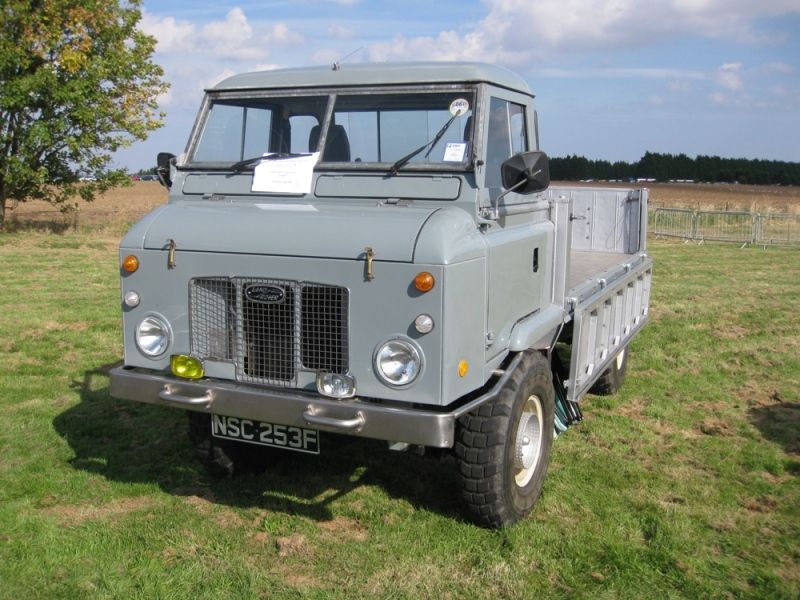
Land Rover’s Forward Control model shared many parts with the conventional Land Rover and with he Rover P3 & P4 saloon cars. In fact, the Land Rover Forward Control’s chassis was pretty much a conventional Land Rover chassis modified to accommodate a cab over wheels. The Land Rover Forward Control’s cab doors and windshield are also selfsame to the conventional Land Rover’s doors. This modified Land Rover chassis, though; was only available with large-sized wheels and tires that caused the vehicle to have a very high ground clearance.
The Land Rover Forward Control was officially known as the FC101 (for Forward Control, 101″ wheelbase).
The engines installed in the Land Rover Forward Control were pretty much the same as in the conventional Land Rover: 4-cylinder gasoline/petrol and diesel engines, intake over exhaust (IOE) inline-6; and the Buick/Rover V8.
The Land Rover Forward Control was primarily designed and built for the British Military and the militaries of the Commonwealth nations; although some were made available to the civilian market on the British homeland and in Australia.
In the civilian marketplace, the Land Rover Forward Control was marketed as a vehicle that could carry a larger load off road due to the vehicle’s forward control design that allowed for increased cargo capacity and a tighter turning radius, a load greater than a conventional Land Rover pickup truck model; and the ability to go off-road that a comparable Ford of Europe, Bedford; or Leyland lorry didn’t have.
All-in-all, the Land Rover Forward Control was the end result of the brilliant work conducted by Rover’s Research & Development department.
The Land Rover Forward Control did spawn a newer successor in the late 1980’s called the Llama. The Llama was produced strictly for the British military, and Land Rover did not want to make the Llama available to the civilian market out of fear that the vehicle would compete with the Mercedes-Benz Unimog.
In the end, Land Rover did not win the order by the British Military to produce the Llama. Instead, Land Rover chose a vehicle that was originally designed and produced by what was Chrysler’s European division and later by Renault; and this Chrysler-designed and Renault-built vehicle suffered poorly in terms of reliability during it’s intended military service
Jeep had also marketed their Forward Control model as a pickup truck with Jeep’s legendary and unquestionable off-road know-how, and carry a larger load off road due to the vehicle’s forward control design that allowed for increased cargo capacity and a tighter turning radius. And indeed, the Jeep Forward Control model had a greater cargo capacity than the conventional Jeep pickup truck that was produced from 1947-1963; and even the Jeep Full-Size J-Series pickup truck that had just been introduced by Kaiser during the Jeep FC’s production run.
Pictures of the Land Rover Forward Control model:


Photos of the Land Rover Forward Control’s successor-the Llama:




 Matthew Parij